Table of Contents
4. Marketing Plan
This chapter presents the marketing plan for Screen2Green. It outlines how the product will be introduced to the market based on insights from the market analysis. A Strengths, Weaknesses, Opportunities, and Threats (SWOT) analysis is conducted to form the foundation for the overall strategy. The chapter further includes strategic objectives, segmentation and targeting, positioning, and the marketing mix. In addition, branding, budgeting, and control measures are addressed to support effective implementation.
4.1 Business Idea Formulation
Before developing a product for the market, it is essential to identify a meaningful customer problem and determine whether an existing gap in the market can be addressed in a new or improved way. In the case of Screen2Green, the starting point was not to create an entirely new category of product, but rather to improve and expand on an existing idea in a more tangible and impactful form. The team was particularly inspired by productivity applications that use virtual plants or forests as a reward mechanism for focused work.
The business idea emerged from observations made in the team’s own daily environment, both in academic settings and in personal life. A common issue identified was the difficulty many people experience in staying focused while studying or working. The growing presence of smartphones and digital platforms has made distractions more constant and harder to avoid. Social media applications are specifically designed to capture attention through notifications, visual stimuli, likes, and other forms of instant feedback. These mechanisms reinforce habitual use and make it difficult for users to reduce screen time or change behavior, even when they are aware of the negative consequences [1][2].
At the same time, the team also identified another common characteristic among many students and young adults: they often live in apartments, shared housing, or student rooms with limited access to gardens or other green environments. This means that, although many people could benefit from the calming and motivating effects of caring for a plant, they may not have the opportunity, time, or confidence to grow something themselves. Research has shown that interaction with plants can contribute positively to emotional well-being and can support feelings of calmness, purpose, and connectedness [3][4][5].
Based on these observations, the team formulated a differentiated market solution. Instead of only rewarding focus with a virtual plant inside an app, Screen2Green extends this concept into the physical world by allowing the user to grow a real basil plant. The solution combines a mobile application with a pot system that links the user’s digital behavior to the condition of the plant. Through focus sessions and screen-time monitoring, the application helps reduce distractions and encourages more conscious smartphone usage. The Smart Pot then translates this behavior into physical plant care by adjusting the watering conditions according to the user’s performance.
This creates a feedback mechanism that is more tangible and emotionally engaging than purely digital alternatives. The user is not only encouraged to focus through app-based features, but also experiences the consequences of their habits through the visible health and growth of a living plant. In addition, the system offers practical value, as the user can grow basil that may later be harvested and used in cooking. The scent and presence of basil may also contribute to a calmer indoor environment. Altogether, the solution aims to support productivity, reduce stress, encourage responsibility, and make healthier digital habits more meaningful in everyday life.
4.2 Business Model
The Business Model Canvas (BMC) (Figure 1) provides a structured overview of how the project could create, deliver, and capture value [6]. In this project, the canvas is used to explore the broader potential of the concept beyond the current prototype. It is important to emphasize that the canvas represents a conceptual and future focused perspective. While the project primarily focuses on developing and testing a prototype, the elements in the BMC illustrate how the solution could be scaled and implemented as a viable business in a real-world context.

4.2.1 Activities, resources, and value proposition
The key activities describe the core processes necessary to develop and deliver the solution [7]. In this project, these primarily involve product development, system integration, and testing of both hardware and software components. While the current work focuses on prototyping and validation, activities such as manufacturing and marketing represent important future steps for scaling and commercialization.
These activities are supported by key resources, which form the foundation of the system [8]. This includes both physical components, such as microcontrollers, sensors, and irrigation systems, and intangible resources, such as knowledge in IoT development, plant care, and user experience design. Together, these resources enable both the functionality of the prototype and its potential further development.
The value proposition, which defines the value created for users, is the core of the project [9]. The concept translates digital behavior into a physical and biological outcome by linking screen time to plant health. This creates a tangible and engaging feedback mechanism that promotes awareness of smartphone usage while simultaneously simplifying indoor plant care and supporting sustainability.
4.2.2 Customer relationships, channels, and customer segments
To ensure continued use, customer relationships focus on how users interact with the system over time [10]. Through the mobile application, users receive ongoing feedback on both their behavior and the condition of the plant. Features such as notifications and gamification are intended to support engagement and encourage consistent interaction, which is essential for influencing user habits.
In order to reach these users, appropriate channels are required [11]. The solution would primarily be delivered through digital platforms such as mobile applications and social media, in addition to potential online and retail distribution. Although these channels are not implemented within the scope of the project, they illustrate how the product could be made accessible in a real-world context.
This is closely linked to the defined customer segments, which include young adults, students, and individuals with high screen-time usage, as well as those interested in digital well-being and self-improvement. Focusing on these groups ensures that the solution targets users who are most likely to benefit from and engage with the concept [12].
4.2.3 Cost structure and revenue streams
From a business perspective, the cost structure outlines the expected expenses related to development, production, and distribution, including hardware components, software development, manufacturing, and marketing [13]. Although these costs are not directly incurred in the project, they provide insight into the economic considerations associated with scaling the solution.
Complementing this, the revenue streams indicate how the solution could generate income, for example through the sale of the Smart Pot device, optional premium features within the application, and complementary products such as seeds or nutrient kits. This highlights the potential for financial sustainability and supports the long-term viability of the concept [14].
Overall, the Business Model Canvas provides a cohesive framework for understanding how the pot could evolve from a prototype into a scalable product. It connects technical development with broader business considerations, highlighting both the requirements and opportunities associated with future implementation.
4.3 Market Analysis
To understand the conditions in which Screen2Green would operate, a market analysis was conducted. This analysis helps identify the main actors, trends, and external forces that may affect the product’s success [15]. In order to provide a structured overview, the analysis is divided into micro-analysis and macro-analysis. The micro-analysis focuses on the immediate environment surrounding the product, while the macro-analysis examines broader external forces.
4.3.1 Micro analysis
Micro-analysis focuses on the factors closest to the project that directly influence its ability to deliver value to customers [16].
Suppliers play an essential role in the development of Screen2Green. The system depends on electronic components such as microcontrollers, sensors, and water pumps, as well as structural materials for the pot itself. Access to reliable and cost-effective suppliers is therefore crucial in order to maintain product quality while ensuring that the final solution remains affordable for the target group.
The primary customer segment consists of students and young adults between the ages of 18 and 30. These users are typically exposed to high levels of screen time, which is associated with negative mental health outcomes [17]. They are also actively seeking ways to improve productivity, mental well-being, and daily habits. In addition, they are generally familiar with mobile technology and are open to adopting innovative solutions that combine digital and physical experiences.
The competitive environment can be divided into two main categories. On one side, productivity applications such as Forest provide digital tools to help users stay focused through gamification and visual feedback. On the other side, smart plant systems focus on automated plant care and indoor cultivation. However, these solutions operate independently and do not combine behavioral feedback with real plant interaction. Screen2Green therefore occupies a unique position by integrating these two approaches into a single system.
In terms of distribution, the product would primarily be offered through digital channels, including online platforms and mobile applications. E-commerce solutions would allow for wide accessibility.
Finally, several stakeholder groups influence the project. Academic supervisors and institutions provide guidance and evaluation, while potential users contribute valuable feedback during the development process. These stakeholders play an important role in shaping both the product and its future market potential.
4.3.2 Macro analysis
Macro analysis examines the broader external factors that influence the environment in which Screen2Green operates [18].
From a political and legal perspective, the product must comply with regulations related to electronic devices and data protection. Since the system involves monitoring user screen-time data, compliance with privacy frameworks such as General Data Protection Regulation (GDPR) is essential. This requires transparent data handling and informed user consent [19].
Economic factors also play an important role. The primary target group consists of students and young adults, who are generally price-sensitive. This means that the product must be designed with affordability in mind, while still delivering sufficient value to justify the cost.
Social and cultural trends strongly support the relevance of Screen2Green. There is an increasing awareness of mental health, digital well-being, and the negative effects of excessive screen use. At the same time, urban lifestyles often limit access to natural environments. This creates a strong demand for solutions that reconnect individuals with nature in a simple and accessible way.
Technological developments enable the realization of the product. Advances in IoT, mobile applications, and sensor technology make it possible to integrate digital behavior with physical systems in real time. These technologies form the foundation of the Screen2Green concept.
Environmental factors are also relevant. There is a growing interest in sustainability and self-sufficiency, particularly among younger generations. The ability to grow herbs at home supports environmentally friendly behavior and aligns with these values.
Finally, ethical considerations must be taken into account. Since the system is designed to influence user behavior, it is important to ensure that it encourages positive habits without creating stress or pressure. In addition, user data must be handled responsibly, with a strong focus on privacy and transparency.
4.3.3 Barriers to entry
Although Screen2Green presents a unique concept, several barriers to entry must be considered. One important barrier is technical complexity. The product requires successful integration between hardware, software, and behavioral logic, which may complicate development and increase production challenges.
Another barrier is market acceptance. Because the concept is relatively unconventional, some users may not immediately understand its value or may be uncertain about linking plant health to personal digital habits. The product will therefore require clear communication and strong demonstration of benefits.
Affordability is also a barrier, since the primary target group may not have a large purchasing budget. Privacy concerns may further affect adoption if users are reluctant to share screen-time data. Finally, Screen2Green must compete with simpler and often free alternatives, such as built-in smartphone features and existing productivity apps. These barriers do not eliminate the market opportunity, but they do require careful strategic planning.
4.4 SWOT Analysis
A SWOT analysis, proposed by Nielsen Norman group, was conducted to evaluate the internal strengths and weaknesses of the concept, as well as the external opportunities and threats that may influence its success [20].
Figure 2 shows the SWOT analysis of the project, including its strengths, weaknesses, opportunities, and threats.

4.4.1 Strengths
The concept demonstrates several key strengths. Firstly, it is based on an innnovative concept that combines IoT technology, behavioral psychology, and indoor gardening. This combined approach makes the product both unique and relevant in today's digital society. Secondly, the system promotes mental well-being by encouraging reduced screen-time monitoring tools, as it introduces a more interactive and meaningful user experience. Additionally, the product provides a visible and tangible feedback mechanism, where the health of the plant reflects the user’s smartphone usage. This makes otherwise invisible digital habits more apparent and easier to understand. The compact design also makes the system suitable for indoor environments such as apartments, aligning well with urban lifestyles. Finally, the concept is inherently flexible and adaptable, allowing for the integration of different plant types. This scalability is considered a strength, as it enables the product to evolve and appeal to a broader range of users without fundamentally changing the core system.
4.4.2 Weaknesses
Despite its strengths, there are has several limitations. One key weakness is the system's technical complexity, as it requires integration between hardware components, sensors, and a mobile application. The current focus on a limited plant variety, such as basil, may also reduce its appeal to a broader audience. Additionally, the system requires regular maintenance, including refilling water and ensuring proper functionality, which may be perceived as inconvenient for some users. Lastly, privacy concerns may arise due to the need to monitor smartphone usage data.
4.4.3 Opportunities
There are several external opportunities that could support the development and adoption of the concept. Firstly, there is a growing interest in indoor gardening and sustainable living, which aligns closely with the product’s purpose and increases its market relevance. In addition, awareness of digital well-being and the negative effects of excessive screen-time is increasing. This creates a demand for innovative solutions that support healthier digital habits, positioning the concept within a relevant and expanding market. Furthermore, there is potential for collaboration with existing applications, such as productivity or well-being platforms. Such integrations could enhance the system’s functionality, improve user experience, and increase its competitiveness in the market. Overall, these external trends provide a strong foundation for further development and potential commercialization of the concept.
4.4.4 Threats
The product also faces external threats that could impact its success. One major challenge is competition from existing built-in screen-time features and mobile applications, which may be perceived as simpler or more convenient alternatives. Additionally, environmental factors such as light, temperature, and humidity may affect plant health independently of user behavior, potentially reducing the reliability of the feedback system. User preferences and trends may also change over time, which could reduce long-term relevance of the concept. Furthermore, there is uncertainty regarding user adoption and market acceptance, as the product ma be perceived as unconventional. Finally, increasing privacy regulations may create additional challenges when handling user data.
4.5 Strategy
An effective marketing strategy is necessary to connect Screen2Green with its intended users and to establish a clear direction for future market entry. This strategy is based on the results of the market analysis and is intended to guide the project in terms of value delivery, audience focus, and competitive differentiation [21].
4.5.1 Strategic Objectives
The primary strategic objective of Screen2Green is to introduce an innovative product that supports healthier digital habits while also promoting mental well-being and engagement with nature. In order to achieve this overall objective, the strategy can be divided into three main dimensions: economic objectives, customer-oriented objectives, and product-oriented objectives.
The economic objectives focus on long-term feasibility and financial sustainability. Screen2Green aims to establish a business concept that could generate revenue through product sales and, in a later phase, potentially through premium app features or complementary items such as seed kits and nutrient products. Another economic objective is to maintain cost efficiency by using accessible components and avoiding unnecessary complexity. This is especially important because the target market is relatively price-sensitive.
Customer-oriented objectives focus on attracting, satisfying, and retaining users. One objective is to achieve early adoption among students and young adults, particularly those who are already familiar with productivity applications and interested in self-improvement. Another objective is to ensure that the system delivers a clear, intuitive, and meaningful user experience so that users understand the relationship between their behavior and the plant feedback. In the longer term, the strategy also aims to build engagement and encourage repeated interaction through the app and the ongoing care of the plant.
Product-oriented objectives relate to innovation, functionality, and user value. Screen2Green aims to maintain a distinctive position by continuing to develop the concept as a hybrid between productivity technology and indoor gardening. Another objective is to ensure that the system remains simple enough for non-technical users while still offering enough functionality to feel innovative and useful. Finally, product development should remain open to future improvements, such as additional plant options, better app integration, or more refined feedback systems.
4.5.2 Segmentation and targeting
To effectively position Screen2Green within the market, a segmentation strategy has been developed based on demographic, behavioral, and psychographic variables [22]. This structured approach enables a more precise identification of user needs and supports the development of a solution that aligns with both functional and emotional user expectations.
Demographic segmentation
From a demographic perspective, the product primarily targets young adults, especially students and early-career individuals. These groups are particularly relevant because they often spend long hours studying or working with digital devices and are more likely to adopt app-connected lifestyle products.
Behavioral segmentation
From a behavioral perspective, the target audience includes individuals who experience high screen-time usage, struggle with distraction, or actively seek methods to improve concentration and time management. These users are likely to recognize the limitations of existing digital solutions and therefore see value in a system that makes digital habits more visible and encourages the development of healthier routines.
Psychographic segmentation
From a psychographic perspective, Screen2Green appeals to users who value self-improvement, well-being, sustainability, and personal responsibility. This segment is typically motivated by the desire to achieve a better balance between digital and physical life. Furthermore, these users are drawn to products that combine functionality with emotional and aesthetic value, particularly those that incorporate natural elements and promote a sense of calm and responsibility.
Targeting strategy and persona
Based on these segmentation factors, Screen2Green adopts a focused targeting strategy centered on students, young adults, and urban users interested in digital well-being and indoor lifestyle solutions. This target group is considered highly relevant, as it demonstrates both a clear need for the proposed solution and a strong likelihood of adoption. Their familiarity with digital tools, combined with an increasing awareness of the negative effects of excessive screen-time, makes them particularly receptive to a hybrid solution that integrates technology with physical interaction.
In order to further refine the understanding of the target audience and support design and communication decisions, a representative marketing persona has been developed, see Figure 3. This persona illustrates a typical user within the target segment and serves as a practical reference point for guiding product development, user experience design, and marketing communication. In particular, it supports decisions related to simplicity, emotional engagement, and the integration of physical feedback mechanisms, which are central to the Screen2Green concept.

- Name: Emma
- Age: 22 years old
- Occupation: University student
- Background and lifestyle: Emma lives in a shared apartment in an urban environment. She maintains a busy daily schedule consisting of lectures, assignments, part-time work, and social activities. A significant portion of her day is spent using digital devices, both for academic purposes and free time. Her daily routine is highly structured but frequently interrupted by digital distractions.
- Behavioral characteristics: Emma frequently experiences difficulty maintaining focus due to constant smartphone distractions, including social media notifications and habitual checking behavior. Although she has previously experimented with productivity applications, she often finds them easy to ignore or disengage from over time. She is open to new solutions but prefers those that integrate naturally into her daily routine.
- Needs and motivations: Emma seeks a solution that helps her manage screen-time and improve concentration without requiring excessive effort or creating additional stress. She values tools that provide clear, intuitive feedback and support gradual and sustainable behavior change. In particular, she is motivated by solutions that make her habits more visible and tangible rather than relying solely on abstract digital metrics.
- Values and attitudes: She places importance on mental well-being, balance, and personal development. Additionally, she has a growing interest in sustainability and appreciates products that incorporate natural elements. Furthermore, she values simplicity, aesthetic design, and emotional engagement, which influence her willingness to adopt and continue using a product.
- Goals and challenges: Emma’s primary goals include improving focus during academic work, reducing unnecessary screen-time, and establishing more structured daily routines. These goals are closely linked to her desire for increased productivity and improved mental well-being. At the same time, she faces several challenges, including frequent digital distractions, difficulty maintaining concentration over time, and a tendency to rely heavily on her smartphone. Existing productivity applications often fail to address these issues effectively, as they are easy to ignore and lack sustained engagement.
4.5.3 Positioning
Positioning defines how Screen2Green should be perceived in the minds of users relative to competing products [23]. The aim is to create a clear and distinctive place in the market by emphasizing the product’s unique combination of productivity support, digital well-being, and physical plant interaction.
As illustrated in the perceptual map, existing solutions can be divided into two main categories based on their level of physical interaction and behavioral influence. Productivity applications such as Forest, Flora, and Focus To-Do demonstrate high behavioral influence but low physical interaction, as they operate purely in a digital environment and rely on user self-regulation. In contrast, physical plant-based solutions, including traditional plant pots, smart farming systems, and the AeroGarden Harvest, offer high physical interaction but limited behavioral influence, as they either require manual care or rely heavily on automation without actively encouraging behavioral change.
Screen2Green is positioned as an innovative and emotionally engaging smart lifestyle product that bridges this gap. Unlike traditional productivity applications, which provide only digital rewards, Screen2Green translates user behavior into visible real-world outcomes through the growth and condition of a living plant. At the same time, unlike smart plant systems that focus primarily on automation and cultivation, Screen2Green introduces a behavioral and motivational dimension by linking digital habits to physical consequences.
This dual functionality places Screen2Green in the upper-right quadrant of the perceptual map, combining high physical interaction with strong behavioral influence. As a result, the concept occupies a unique position between digital self-regulation and indoor well-being, highlighting a gap in existing market offerings. As illustrated in Figure 4, Screen2Green differentiates itself from both traditional productivity applications and automated plant-care systems by integrating behavioral motivation with tangible physical interaction. This positioning supports the product’s value proposition as a hybrid solution that combines productivity support, sustainability, and emotional engagement.

4.5.4 Marketing-Mix
The marketing mix provides a framework for translating strategy into practical market actions. The four main components are Product, Price, Place, and Promotion (4 Ps) [24]. For Screen2Green, the marketing mix is especially important because the concept combines both physical and digital elements. The solution is not only a physical product, but also a service and user experience that connects digital behavior with real-world interaction. This positions Screen2Green as a hybrid offering.
Product
The core product consists of a smart indoor pot integrated with a mobile application. The system enables users to grow a plant while simultaneously monitoring and influencing their screen-time behavior through focus sessions and behavioral feedback mechanisms. From a marketing perspective, Screen2Green represents more than a purely tangible product. It combines physical components, digital services, and emotional experiences into a hybrid offering. The pot itself provides practical functionality through automated irrigation and plant monitoring, while the mobile application offers behavioral tracking, notifications, and productivity support. Together, these elements create an interactive user experience that differentiates the concept from traditional productivity applications and ordinary smart plant systems.
The product also creates emotional and symbolic value. The visible growth and condition of the plant provide a tangible representation of the user’s digital habits, making otherwise invisible behavior more meaningful and easier to understand. In addition, the presence of greenery indoors may contribute to calmness, well-being, and aesthetic value in urban living environments. Because Screen2Green is currently in the introduction stage of the Product Life Cycle (PLC), the primary product objective is to create awareness and encourage early adoption. At this stage, the product should focus on delivering clear core functionality while communicating its unique value proposition effectively.
Price
Screen2Green would primarily follow a value-based pricing strategy. Rather than setting the price solely based on production costs, the pricing reflects the perceived value created through the combination of productivity support, emotional engagement, sustainability, and smart technology integration. At the same time, pricing decisions must consider both internal and external factors, including development costs, competitor pricing, customer purchasing power, and perceived customer value [25]. Since the primary target group consists of students and young adults, affordability remains particularly important.
Based on the estimated prototype cost of approximately 72.44 €, the expected retail price could range between 70 € and 100 €. This range positions the product as affordable but still innovative enough to communicate quality and uniqueness.
As a new product entering the market, Screen2Green would most likely benefit from a market penetration pricing strategy during the early stages of commercialization. This approach involves setting a relatively accessible price in order to attract a larger number of users quickly and increase market adoption [26]. Because the target market is relatively price-sensitive, a penetration strategy may support faster awareness, stronger word-of-mouth promotion, and broader market reach among students and young adults. In the future, additional revenue streams could be introduced through optional premium application features, subscription-based productivity tools, or complementary products such as seed kits and nutrient packs.
Place
The distribution strategy for Screen2Green focuses primarily on direct-to-consumer and digital distribution channels. The product would initially be sold through a dedicated website and major e-commerce platforms such as Amazon, while the application would be distributed through Google Play Store and Apple App Store. Physical retail partnerships could later be established with electronics and lifestyle retailers such as Worten, Fnac Portugal, and Leroy Merlin. These intermediaries may help increase accessibility, visibility, and customer trust by providing existing distribution networks, retail expertise, and market reach [27].
In addition, university campuses and student organizations represent highly relevant pilot distribution environments due to their direct connection to the target audience. These channels would support early testing, product demonstrations, and feedback collection. The chosen distribution channels should ensure that the product is both easily accessible and aligned with the purchasing behavior of digitally active consumers. Because Screen2Green combines hardware and software, efficient coordination between physical distribution and digital app availability is essential.
Promotion
The promotional strategy for Screen2Green should focus on creating awareness, educating consumers, and communicating the emotional and practical benefits of the concept. Since the product introduces a relatively new behavioral approach, promotion must clearly explain how the system works and why it provides value to users. An Integrated Marketing Communications (IMC) approach would be particularly suitable. IMC involves coordinating multiple communication channels to deliver a clear, consistent, and compelling message about the product and brand [28]. This is important for Screen2Green because the concept combines technology, well-being, sustainability, and lifestyle elements that must be communicated coherently. Social media platforms such as TikTok, Instagram, and YouTube would likely serve as the primary communication channels due to their relevance for the target audience. Visual content demonstrating plant growth, focus sessions, and real-life student usage scenarios would help communicate the concept effectively.
The communication mix could include several promotional tools:
- Advertising: Social media advertisements and short-form video campaigns can build awareness and explain the concept visually.
- Public relations: Collaborations with universities, digital well-being campaigns may increase credibility and public visibility.
- Sales promotion: Introductory discounts, student bundles, or seed-kit giveaways may encourage early adoption.
- Direct marketing: Personalized communication through app notifications, newsletters, and email campaigns may support long-term engagement and customer retention.
Since Screen2Green is positioned in the introduction stage of the PLC, informative advertising is especially important. The main promotional objective at this stage is to educate consumers, stimulate interest, and create awareness of the new product category [29].
4.5.5 Brand
Branding is important because Screen2Green is not only a functional product, but also an experience-based concept that relies on emotional resonance and user identification. The brand should therefore communicate calmness, growth, balance, and self-improvement. The name Screen2Green clearly reflects the central idea of the concept. “Screen” represents digital habits, smartphone use, and the challenge of excessive screen time, while “Green” represents nature, plants, health, and renewal. Together, the name communicates a transformation from digital overload to healthier and more natural habits. The words also have similar pronounciation, making the name memorable and easy to recognize. Additionally, this makes the name both descriptive and memorable.
The visual identity was designed to reinforce the connection between technology and nature. The logo in Figure 5 shows green tones (#aac03e and #637f30) that were selected to represent plants, growth, health, and sustainability, while a brown tone (#5f4228) symbolizes soil and the natural environment in which the plant grows. These color choices support the emotional positioning of the product and strengthen the association between digital well-being and nature-based interaction.
The logo further reinforces this identity through a combination of typography and symbolism. In the logo, the word “to” is replaced by the number “2”, which shares the same pronunciation while also being stylized to resemble a small growing plant. This creates a visual representation of transformation and growth while maintaining a modern and recognizable appearance. The logo also incorporates organic shapes and plant-inspired elements that connect directly to the product’s purpose. The regular version of the Univers Condensed typeface was selected to create a clean, simple, and professional visual expression that aligns with the product’s focus on clarity, balance, and reduced distraction.

In addition to the logo and slogan, several communication materials were developed to support the branding strategy and strengthen product visibility. These include a flyer, a tri-fold leaflet, and a promotional poster. All materials follow a consistent visual identity through the use of green and earthy color palettes, natural imagery, soft backgrounds, and clean layouts. This consistency helps create a cohesive brand experience across different communication platforms and reinforces the product’s association with calmness, mindfulness, sustainability, and healthier digital habits.
Flyer
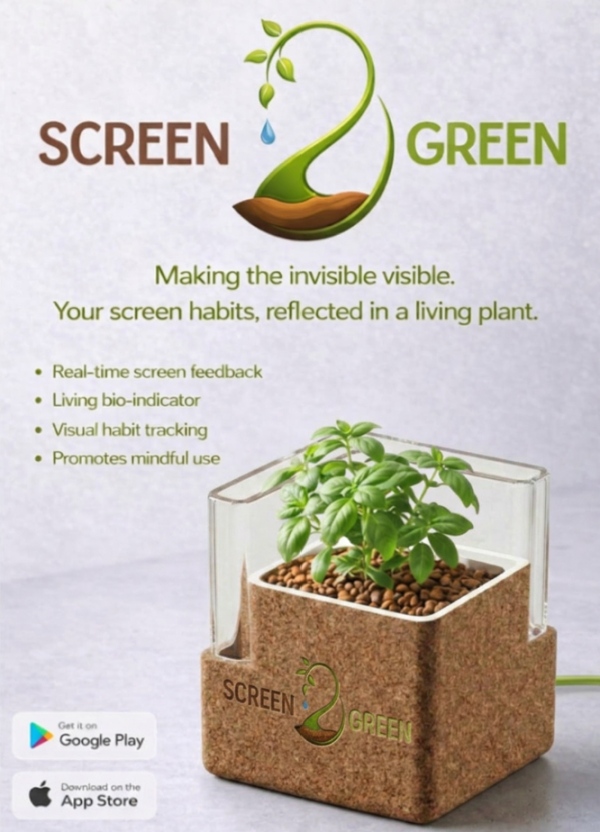
The flyer seen in Figure 6 was the first design of the flyer. The primary goal of this first version was to communicate the core idea of the product and establish a visual identity that reflected the connection between technology and nature. The flyer introduced the Screen2Green concept, the logo, the slogan, and the main product features while exploring how these elements could be combined into a coherent promotional material. During evaluation, several areas for improvement were identified. The layout lacked a clear visual hierarchy, some information competed for attention, and the product benefits were not communicated as effectively as intended. While the overall concept and visual direction were considered appropriate, the design required refinement to improve readability, structure, and branding consistency.
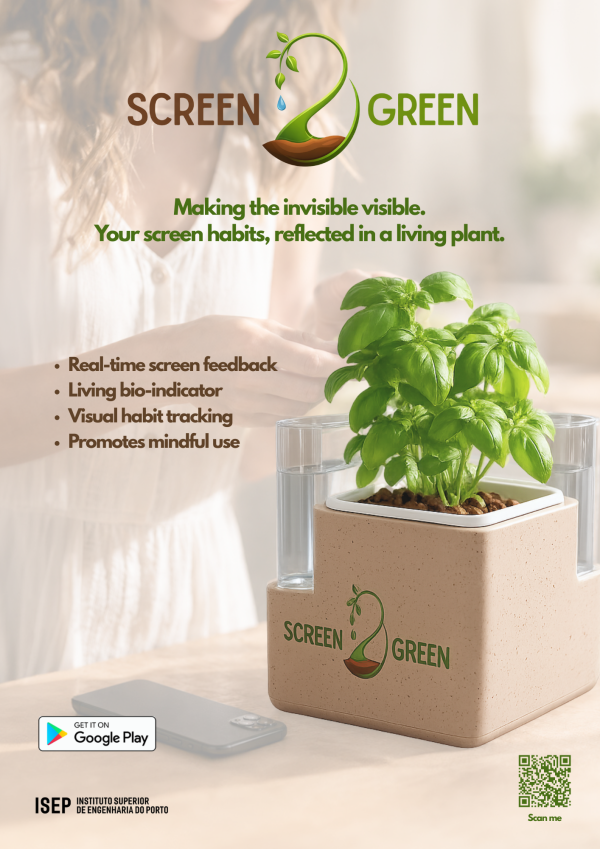
As a result, the flyer was redesigned and refined into the final version seen in Figure 7. The Screen2Green logo is positioned prominently at the top of the flyer to strengthen brand recognition. A light gray background (#d9d8dd) was chosen to create a clean and neutral foundation, while green accents (#aac03e) reinforce the product’s connection to nature and growth. Below the logo, short explanatory text introduces the concept in a simple and accessible manner. A series of concise feature descriptions highlights the main benefits of the product, including focus support, plant growth feedback, and screen-time awareness. A high-quality render of the pot and plant is displayed alongside these features to provide a clear visual representation of the product. App Store and Google Play icons are included at the bottom of the flyer to emphasize the connection between the physical product and its accompanying mobile application.
The final flyer also incorporates the slogan “Making the invisible visible,” which strengthens the brand identity by emphasizing the product’s core concept. Screen habits and digital behavior are often difficult for users to perceive in a meaningful way. By translating screen usage into the visible condition and growth of a living plant, Screen2Green creates a physical representation of digital habits. The slogan therefore communicates both behavioral awareness and personal responsibility in a concise and memorable way. The redesign process focused on improving visual consistency with the overall branding strategy. The final flyer uses calming colors, natural imagery, and a minimalistic layout to create an emotionally positive impression that aligns with the project's focus on mental well-being and balanced technology use. The cleaner structure, improved visual hierarchy, and more focused messaging make the final flyer easier to read and more effective at communicating the value proposition of Screen2Green.
Leaflet
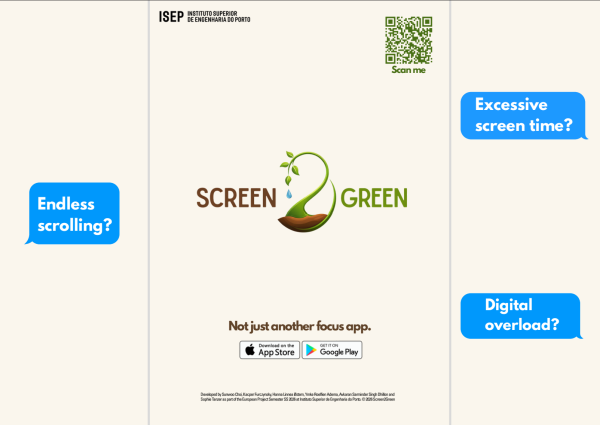
A gatefold leaflet was also developed to provide more detailed information about the product, its purpose and its functionality. Compared to the flyer, the leaflet allows for more in-depth communication while still maintaining a visually approachable presentation style. The front panels seen in Figure 8 use questions such as “Excessive screen time?”, “Endless scrolling?”, and “Digital overload?” in order to immediately engage users and create identification with common digital well-being challenges. This approach helps establish emotional relevance before introducing the product solution.
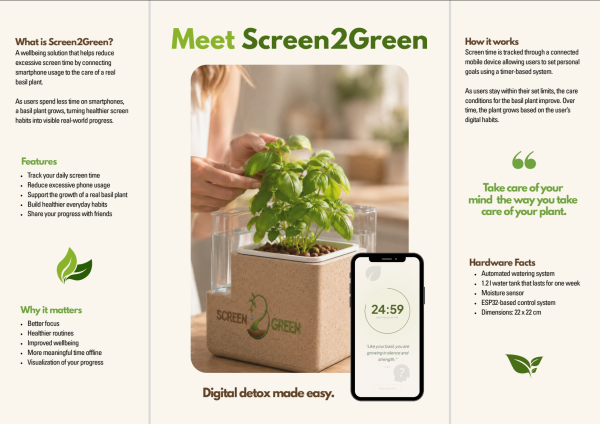
Inside the leaflet, the system functionality, hardware components, behavioral benefits, and product features are explained through concise text sections supported by visuals. The leaflet also emphasizes how the system encourages healthier habits through visual plant feedback and mindful interaction. By combining emotional messaging with practical product information, the leaflet supports both user engagement and product understanding.
Poster
A promotional poster was developed as part of the overall communication strategy to support presentations, exhibitions, and public product promotion. The poster combines the physical prototype with the mobile application interface in order to visually demonstrate the integration between hardware and software. Figure 10 shows the poster that highlights several key behavioral and psychological benefits of the system, including reduced digital overstimulation, improved focus, and healthier screen habits. The use of concise statements, visual hierarchy, and strong product imagery allows the main concept to be communicated quickly and effectively even at a distance.
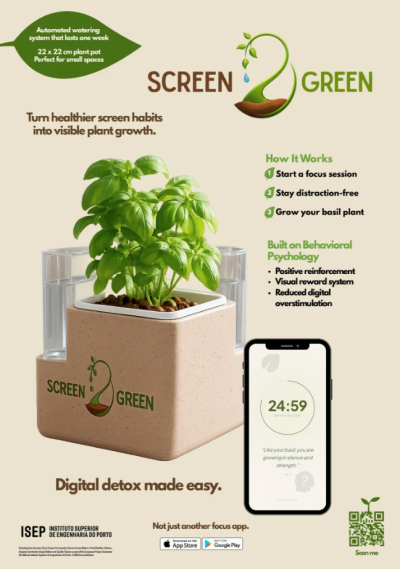
The consistent use of typography, color palettes, logo placement, and natural imagery across the poster, flyer, leaflet, and logo contributes to stronger brand recognition and a more professional market identity. Maintaining consistency across communication materials is important for improving memorability, building credibility, and establishing a cohesive brand presence. Overall, the Screen2Green branding strategy was designed not only to promote the product itself, but also to communicate broader values related to sustainability, mindfulness, healthier digital behavior, and reconnection with nature. The combination of emotional messaging, natural symbolism, and technological integration helps position Screen2Green as both a functional smart product and a meaningful lifestyle-oriented experience.
4.6 Marketing Programmes
Several marketing programmes could support the introduction of Screen2Green and help build early adoption among the target audience. Since the product combines productivity, sustainability, and well-being, the marketing strategy should focus on creating awareness, encouraging user engagement, and communicating the emotional and practical value of the concept. The selected programmes are primarily designet to target students and young adults, as these groups are highly active on digital platforms and are more likely to adopt new technological and lifestyle-oriented products.
4.6.1 Programmes
University Pilot Programme
A university pilot programme would be particularly suitable as an initial entry strategy. Since students are one of the primary target groups, testing the product in university environments would allow the team to observe real usage patterns, gather user feedback, and refine both the physical system and app experience.
The pilot programme would also contribute to increasing brand awareness among a relevant audience through direct interaction with the product. Selected participants could test the product during a limited trial period and provide feedback regarding usability, motivation, and functionality. This approach can reduce market uncertainty while validating both the product concept and the business model.
Social Media Campaigns
Social media campaigns would also play an important role in communication strategy. Platforms such as Instagram, TikTok, and Facebook are especially relevant for reaching younger audiences and visually demonstrating the concept.
These campaigns explaining how the product works, highlighting benefits related to productivity and well-being, demonstrating plant growth linked to reduced screen time, and sharing user experiences. Additionally, since the product has a strong visual and symbolic dimension, it's well suited to content-based digital marketing. Short-form videos, before-and-after demonstrations, and lifestyle-oriented content could help create engagement and increase visibility.
Product Launch Campaign
A product launch campaign could be used in a later stage to introduce the concept more broadly. The purpose of this programme would be to generate attention, encourage first-time adoption, and strengthen the product's market presence. This could include a short promotional video, limited introductory offers, or bundles that combine the device with seeds or app access. The purpose would be to create attention and encourage first-time adoption. Such activities could help stimulate initial demand .
Influencer Collaboration Programme
Finally, influencer collaborations could help communicate the concept in a more relatable and authentic way. Creators focused on student life, productivity, wellness, or interior lifestyle could demonstrate how Screen2Green fits naturally into daily routines. This programme could incole product demonstrations, integration into study or work environments, daily usage content, and reviews focused on productivity and digital balance. This type of promotion could increase both credibility and reach, while also strenghten the emotional connection with potential users.
4.6.2 Budget
As Screen2Green is currently in the introduction stage of the product life cycle, the primary marketing objective is to create awareness and encourage product trial among early adopters. During this phase, marketing investments are expected to focus mainly on digital communication channels and low-cost promotional activities that can efficiently reach the target audience. Successful product launches often require investment in multiple communication activities, including social media advertising, influencer partnerships, promotional campaigns, and content creation. The source also highlights that marketing budgets should prioritize visibility, audience targeting, and measurable customer acquisition strategies [30].
Since Screen2Green is currently developed as a prototype and startup-scale concept, the proposed marketing budget is significantly smaller than large-scale commercial launches. Instead, the strategy focuses on cost-efficient digital promotion and highly targeted communication toward students and young adults. The estimated budget presented in Table 1 is adapted from typical startup marketing allocation and launch campaign recommendations, but scaled to fit the smaller scope of the project [31].
| Category | Description | Estimated monthly cost (EUR) |
|---|---|---|
| Social media advertising | Paid advertisements on Instagram, TikTok, and Facebook to increase awareness and traffic | 400 - 700 € |
| Content creation | Photography, short-form videos, editing, and graphic design for promotional content | 150 - 300 € |
| Influencer collaborations | Partnerships with micro-influencers focused on productivity, wellness, and student lifestyle | 250 - 500 € |
| University promotion | Flyers and student ambassador programs | 75 -150 € |
| Product launch campaign | Introductory offers, giveaways, and launch-related promotion | 150 - 250 € |
| Analytics and monitoring tools | Campaign tracking and social media analytics | 50 - 100 € |
| Total | 1075 - 2000 € |
The largest share of the budget is allocated to social media promotion and influencer collaborations, as these channels provide strong targeting opportunities and measurable engagement among the intended audience. Additionally, digital campaigns allow continuous monitoring and optimization based on campaign performance.
4.6.3 KPI and Performance Objectives
To evaluate whether the marketing strategy achieves the desired results, Screen2Green have established measurable key performance indicators (KPIs). KPIs are measurable values used to assess how effectively marketing objectives are being achieved. By monitoring these indicators, the company can evaluate campaign success, identify areas for improvement, and continuously optimize marketing activities [32].
For Screen2Green, several marketing KPIs are particularly relevant during the introduction phase of the product. Engagement metrics, such as likes, shares, comments, and follower growth, can be used to evaluate how well promotional content resonates with the target audience. Additionally, click-through rate (CTR) can indicate how effectively advertisements generate interest and website traffic. Conversion rate is another important KPI, as it measures the proportion of users who complete a desired action, such as downloading the application, registering for the pilot programme, or purchasing the product [33].
From a cost-efficiency perspective, metrics such as cost per acquisition (CPA) and customer acquisition cost (CAC) are also important. These indicators measure how much it costs to acquire a new customer and help evaluate whether marketing investments are financially sustainable. Lower acquisition costs combined with higher conversion rates indicate a more efficient marketing strategy. By continuously tracking these KPIs, Screen2Green can make data-driven decisions, identify areas for improvement, and allocate marketing resources more strategically [34].
During the introduction phase, the primary objectives are to increase brand awareness, generate user engagement, encourage pilot participation, and promote early adoption of the product and application. Therefore, the key performance indicators for Screen2Green should focus on awareness, engagement, user acquisition, and retention. The KPI targets presented in Table 2 are adapted from commonly used digital marketing performance metric and benchmark recommendations [35]. These targets are scaled to fit the smaller scope and startup-oriented nature of the Screen2Green project.
| KPI | Target | Purpose | Measurement method |
|---|---|---|---|
| Social media followers | 2000-3000 followers within the first year | Measure brand awareness growth | Platform analytics |
| Engagement rate | > 5-7 % engagement rate | Evaluate how well the content resonates with users | Likes, comments, shares, saves |
| Conversion rate | > 3-5 % | Measure how many users complete desired actions such as app downloads or sign-ups | Website and app analytics |
| Click-through rate (CTR) | > 2-3 % | Measure advertisement effectiveness and interest generation | Advertisement analytics |
| App downloads | 300 - 500 downloads within the first six months | Measure early adoption | App analytics |
| Pilot programme participation | 100-200 participants | Evaluate interest in university testing programme | Registration data |
| Monthly active users | 50-60 % active users after installations | Measure long-term engagement and retention | App usage statistics |
| Customer acquistion cost | < 25 € per customer | Evaluate cost-efficiency of marketing activities | Marketing cost analysis |
| Influencer campaign reach | > 10 000 impressions | Measure campaign visibility and exposure | Influencer and social media analytics |
| Website traffic | > 3000 website visits | Measure campaign-generated traffic | Google Analytics |
4.6.4 Control
To ensure that the marketing strategy is implemented effectively and improved over time, a structured control method is necessary. One suitable approach is the Plan, Do, Check, and Act (PDCA) cycle [36].
Plan
In the planning phase, Screen2Green defines its marketing objectives, target groups, budget allocation, communication channels, and KPIs. During the introduction pahse, the primary objectives are to increase brand awareness, generate user engagement, encourage participation in the university pilot programme, and promote early adoption of the product and application. Clear benchmarks are established to evaluate success, including targets related to social media engagement, app downloads, and website traffic.
Do
In the implementation phase, the planned marketing activities are executed. These activities include social media campaigns, university pilot programmes, and influencer collaborations. The objective is to reach the intended target audience effectively and create awareness and interest around the Screen2Green concept.
Check
In the checking phase, the team would evaluate performance by comparing actual results with the predefined KPIs. This includes collecting and analyzing data from social media anlytics, website traffic statistics, app usage analytics, registration data, and user feedback. Several performance indicators are particularly important during this phase, including engagement rate, conversion rate, CTR, app downloads, and monthly active users. For example, if the engagement rate falls below the target range of 5-7 % or if conversion rates from advertisements are lower than expected, adjustments may be made to campaign design, platform selection, or communication strategy.
Act
Based on the evaluation results, corrective improvements are implemented to optimize future marketing performance. These improvements may include reallocating marketing budget between communication channels, adjusting promotional content, refining the target audience, or modifying strategies based on user feedback.
By continuously repeating the PDCA cycle, Screen2Green can maintain a data-driven and adaptable marketing strategy that supports long-term growth, improves user engagement, and increases the effectiveness of marketing investments [37].
4.7 Summary
This chapter presented the marketing plan for Screen2Green and showed how the concept could be positioned and introduced in a future market context. The analysis demonstrated that the product addresses a relevant and growing challenge related to digital distraction, productivity, and mental well-being. At the same time, it responds to increasing interest in indoor living, sustainability, and meaningful user experiences.
Based on the market and economic analysis, the team decided to develop a smart indoor plant-growing system aimed primarily at students and young adults with high screen-time usage and an interest in self-improvement and digital well-being. This decision is supported by the lack of existing products that combine productivity support with real plant interaction. Consequently, the proposed solution includes features such as screen-time integration, focus sessions, plant-based feedback, app communication, and a compact indoor design. These features were selected not only for technical reasons, but also because they respond directly to user needs and market opportunities.
The findings of this chapter provide a strategic foundation for the project and justify the market relevance of the concept. They also show that long-term success depends not only on functionality and innovation, but also on responsible design and sustainable implementation. For this reason, the following chapter focuses on eco-efficiency measures for sustainability and examines how Screen2Green can reduce environmental impact while maintaining value and performance.